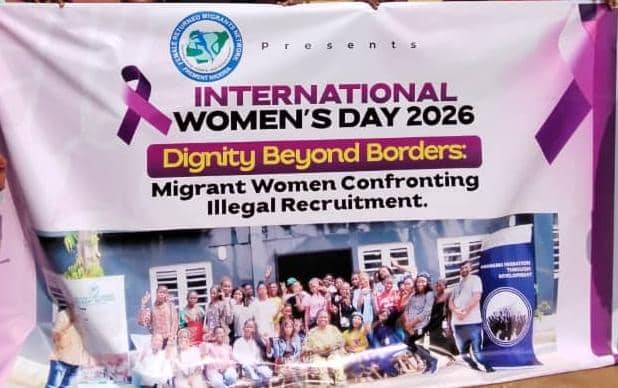
Dialogue on Recruitment, Protection and Accountability
As part of activities around the International Women’s Day 2026, more than 30 returnee women met at the FREMNET empowerment center in Ikorodu to discuss issues around illicit recruitment and the consequences in relation to women. The meeting was organized by Female Returned Migrants Network (FREMNET) in cooperation with Network Refugees4Refugees, Germany.
Background
The dialogue was necessitated by the repeated concerns arising from engagements with recruitment actors in relation to the Federal Ministry of Labour and employment claim that government institutions have no control over recruitment outside recognized recruitment structures. This statement was made at the Voluntary National review of the Global compact on Migration in 2026.
For women who had been victims of deceptive or illegal recruitment, deeper questions on state responsibility in preventing, identifying and responding to attempts of illegal recruitment before the exploitation occurs? The International Women’s Day conversation provided this opportunity to explore these questions from the perspective of returnee women who had been victims of recruitment-related exploitation and abuses.
Rather than a conventional workshop, the meeting was organized as dialogue session for women to freely speak about their experiences with recruitment, promises made and the information available as at that point in time, circumstances from departure to arrival at the destination, the agencies or institutions from which assistance was sought and strategies for preventing illicit recruitment practices.
For many of the participating Migrant, the concerns were not just the experiences of being deceived or exploited, but the attitude and negligence of government agencies in having justice for those migrants who may have summoned the courage to demand for justice on claims of exploitation, violence and abuses by recruitment agencies.
The Women emphasized the need for structure where victims would be heard rather than being blamed or prejudiced for embarking on the initial decision in the first place. The women lamented about how agencies saddled with the opportunity to protect victims would at any complain from migrants victims often begin with questions like;
Why did you trusted a recruiter ?
Why did you not verify certain information ?
Why did you not approach a government institution before accepting an opportunity ?
The participants however questioned why illegal recruiters are able to operate openly, present themselves as legitimate businesses, advertise employment opportunities and target people searching for work.
While access to accurate information is important, the participants emphasized that such approach will only shift responsibility from taking legal actions against illegal recruiters but rather underplay the need to protect the victims and prevent the illicit acts but to push the blames on the migrant victims.
The discussion highlighted the need for supporting structures that would create rooms for victims to be heard and understood on the circumstances around recruitment without judgement. Participants also stressed the need to move beyond downplaying the prevention of illegal recruitment as a responsibility of the prospective migrants rather than accepting it as a responsibility of government and its related agencies.
With Nigeria being a large country with a significant Labour market, a growing number of people continue to seek labour opportunities both locally and internationally. In such an environment, individuals would always encounter illegal businesses or recruiters that presents themselves as legitimate even when their activities does not comply with officially established procedures regulations.
The women therefore called on government to engage in preventing illegal recruitment, engage in proper monitoring, provide public information and create mechanisms for accountability. Considering the government statement that authorities have no control over illegal recruitment does create a gap for illegal recruiters to thrive. The conversation stressed that Government through the institutions responsible for Labour, migration, recruitment regulation and protection must continue to examine how illegal recruiters operate, how people are targeted and how government agencies can intervene earlier.
During the conversation, the women consistently emphasized on the following urgent needs;
- Access to proper information before recruitment and migration decisions were made.
- Platforms for verification of suspicious recruitment opportunities.
- Uncomplicated procedures to report illegal recruiters
- Responsibility of government Institutions to complaints.
- The need to be heard rather than just blame for the exploitation that had already occurred.
Participants emphasized that survivor support must recognize the imbalance of information and power that often exists between recruiters and the people they target. Prevention cannot be depend entirely on asking individuals to protect themselves from actors who operate openly within the Nigerian system.
The dialogue was not only an opportunity to document experiences. It became a space for collective reflection on how those experiences could inform future advocacy, prevention and engagement with government institutions. Participants discussed the importance of targeted awareness for groups frequently approached with employment opportunities and the need for recruitment-related information to reach people before they enter exploitative arrangements.
The conversation also strengthened FREMNET’s understanding of how survivor-led organisations can engage government institutions on illegal recruitment. The discussion pointed toward a broader question of institutional responsibility rather than approaching the issue only from the perspective of awareness campaigns.
The following questions will continue to inform FREMNET’s engagement and advocacy.
- What systems exist to detect illegal recruiters?
- Where can prospective workers verify recruiters?
- How accessible are those systems?
- What happens when illegal recruiters operate outside recognized structures?
- Who is responsible for investigating them?
- How can people with lived experience contribute to designing better prevention mechanisms?
The Women’s Empowerment Center as a Safe Space
The International Women’s Day gathering demonstrated the importance of having spaces where women could meet and speak about critical migration experiences without feeling exploited, judged or overwhelmed. Such space is what the FREMNET Women’s Empowerment Center offers. A space where Women could come together, share experiences with one another and recognize that their stories can no longer be collected simply as testimonies but as contributing to wider conversation about dignity, rights, protection and accountability.
One distinction that matters was that Survivors should no longer be invited simply to recount about what had happened to them. Their knowledge and perspectives is very essential in any conversations that is meant to address the situation that concerns them. The affected women were therefore encouraged to see themselves not simply as victims of illegal recruitment, but as survivors whose perspectives could shape decisions that will prevent similar harms for many others.
The message from the women was very clear:
Public awareness alone is not enough. It was emphasized that effective prevention requires promoting self organized space to empower self determination for survivors. In such spaces like the FREMNET empowerment center, victims of recruitment-related exploitation could be encourages to share experiences and empower one another.
We appreciate the Network Refugees4Refugees for the support in making this conversation possible and more also for facilitating our video presentation during the International women day events in Stuttgart Germany.
By FREMNET Team